


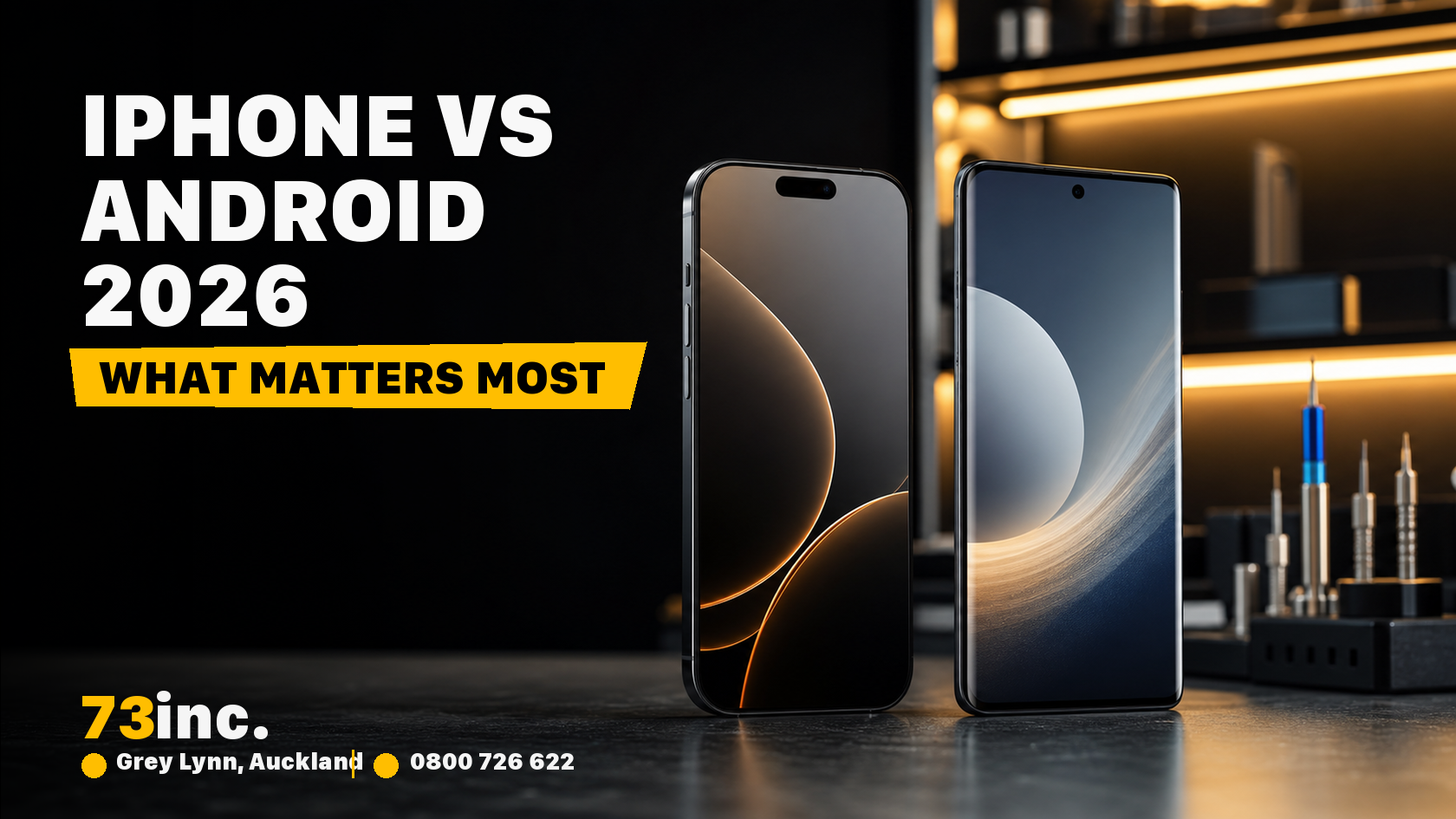
When it comes to choosing your next smartphone, the conversation always comes back to the same question: why is the iPhone better than Android? Both platforms have matured significantly, but in 2026, Apple’s iPhone has extended its lead in the areas that matter most: performance, AI privacy, ecosystem integration, long-term software support, and resale value.
At 73inc, Auckland’s trusted Apple repair specialists, we work with iPhones every day. We see first-hand how well they hold up over years of use, how confidently they retain their value, and how much smoother the ownership experience is compared to most Android alternatives.
Here is a fully updated, detailed breakdown, backed by 2026 data, of why the iPhone remains the smarter choice, and what is coming next.
1. Performance: The A19 Chip No Android Can Match
The iPhone 17 series ships with Apple’s A19 chip, built on advanced 3-nanometer technology. In 2026 benchmark tests, the iPhone 17 achieves an average frame rate of 130.97 FPS: compared to 80.58 FPS on Google’s Pixel 10, a substantial and measurable gap in graphical and processing performance.
For everyday tasks, gaming, video editing, or running Apple Intelligence features locally on-device, no Android chip currently matches it for single-core speed and power efficiency. Apple’s silicon is the reason iPhones feel fast years after purchase, not just on the day you buy them.
Quick Answer: Is iPhone faster than Android in 2026? Yes. The Apple A19 chip benchmarks significantly faster than flagship Android processors in both single-core and graphics performance tests.
2. Apple Intelligence: Private AI Built Into Your Phone
This is the biggest new chapter in 2026. Apple Intelligence, built into iOS 26, has arrived as a genuine, privacy-first AI platform that goes far beyond what any Android manufacturer offers at a system level.
What Apple Intelligence does on iPhone 17 and iPhone 17e:
- Live Translation: Automatically translates conversations in Messages, FaceTime, and Phone calls without leaving the app
- Writing Tools: Rewrites, summarises, and proofreads text across Mail, Notes, and third-party apps
- Visual Intelligence: Lets users search, ask questions about, and take actions on whatever is on their screen
- Clean Up (Photos): Removes unwanted objects from photos with a single tap
- Smarter Siri: Understands natural language, takes on-screen actions, and integrates with ChatGPT for broader knowledge
- Call Screening: Screens unknown callers and asks the reason for calling automatically
- Hold Assist: Holds the line until a live agent is available
- Image Playground: Generates AI images directly inside Messages and creative apps
Why Apple Intelligence beats Android AI on privacy:
Apple processes most AI tasks directly on-device using the A19 chip’s Neural Engine. When a task needs more computing power, it uses Private Cloud Compute, Apple’s secure server infrastructure built on Apple silicon, without storing your data. Google’s Android AI features are powerful, but they send far more data to the cloud by default.
In January 2026, Apple announced a multi-year partnership with Google to incorporate Gemini models into future Apple Intelligence features, meaning Apple’s AI capabilities will only grow, while still running inside Apple’s privacy framework.
Quick Answer: Does iPhone have AI features in 2026? Yes. Apple Intelligence on iOS 26 includes Live Translation, Writing Tools, Visual Intelligence, smarter Siri, and on-device image generation, all designed with privacy at every step.
3. Security and Privacy: Apple’s Strongest Card
Security has always been an iPhone advantage, and in 2026, that lead has widened.
- Closed ecosystem app vetting: Every app is reviewed before it reaches the App Store, dramatically reducing malware exposure
- Simultaneous security updates: All supported iPhones receive iOS security patches on the same day, not weeks or months later, depending on the manufacturer
- Face ID with on-device processing: Facial recognition data never leaves your device
- End-to-end encryption: iMessage, FaceTime, and iCloud data are encrypted by default
- App Privacy Labels: Every App Store listing must declare what data it collects and why
- Private Cloud Compute: For AI tasks that need server processing, Apple’s infrastructure is purpose-built not to retain user data
Android’s update fragmentation remains a real security risk in 2026. While Google Pixel now offers 7 years of updates and Samsung offers 4 years for flagships, the majority of Android devices on the market still receive only 2–3 years of security patches, leaving millions of users exposed.
4. iOS 26: The Biggest Redesign in Years
iOS 26 introduces Liquid Glass: Apple’s most significant visual redesign since iOS 7. The new design language makes apps and system experiences more expressive and content-focused, while keeping the interface instantly familiar.
iOS 26 also includes:
- Adaptive Power mode for extended battery life
- Deeper Apple Intelligence integration across built-in apps
- Expanded Live Translation language support
- New personalisation options throughout the system
For 73inc customers, this matters because iPhones you purchase or repair today, including the iPhone 15, 16, and 17 series, will all receive iOS 26 and its features. You are not buying a device that gets left behind next year.
5. Long-Term Software Support: 6+ Years
Apple typically supports iPhones for 5 to 7+ years after release. A phone purchased today in 2026 will receive security patches and new features well into the early 2030s.
2026 software update comparison:
| Manufacturer | Guaranteed OS Updates |
| Apple (iPhone) | 5–7+ years |
| Google Pixel | 7 years |
| Samsung Galaxy (flagship) | 4 years OS / 5 years security |
| Other Android brands | 2–3 years (typical) |
This longevity directly affects your value for money. It also means that when you bring your iPhone to 73inc for a repair, we are fixing a device with years of useful life still ahead of it, not one that will be unsupported in 12 months.
Quick Answer: How long does Apple support iPhones with updates? Apple supports iPhones for 5 to 7+ years after release, consistently longer than the majority of Android manufacturers.
6. The Apple Ecosystem: Everything Works Together
No Android manufacturer can replicate the seamless connection between iPhone, iPad, MacBook, Apple Watch, AirPods, and Apple TV. These are not just marketing claims, they are daily practical benefits:
- AirDrop: Share photos, files, and links instantly between Apple devices, no app needed
- Universal Clipboard: Copy on iPhone, paste on Mac
- Continuity Camera: Use your iPhone as a wireless Mac webcam
- Handoff: Start writing an email on iPhone, finish it on your MacBook
- iMessage on Mac: All your messages, across every screen
- Apple Watch integration: Health data, payments, and unlocking your Mac from your wrist
- Find My network: Locate all your Apple devices from one place
In 2026, Apple Intelligence deepens this further. Siri can take actions across your apps and devices based on what is on your screen, regardless of which Apple device you are using.
Android’s ecosystem is fragmented across Samsung, Google, Motorola, OnePlus, and dozens of other manufacturers. Cross-brand features exist but require third-party apps or significantly more setup.
7. Resale Value and Long-Term Worth
iPhones hold their value better than any Android competitor, consistently and by a significant margin.
- iPhone users represent the majority of the premium smartphone market globally
- Resale prices for iPhones remain closer to original purchase price, even 2–3 years after release
- The combination of long software support and premium build quality keeps demand for used iPhones high
At 73inc, we regularly buy and sell refurbished Apple devices. The resale market for iPhones is active, predictable, and consistently strong. If you plan to upgrade in a few years, the iPhone you buy today will return more money than almost any Android equivalent.
Quick Answer: Do iPhones hold their value better than Android phones? Yes. iPhones consistently retain resale value better than Android devices, including premium Samsung and Google Pixel models.
8. Camera Quality: Consistency You Can Count On
The iPhone 17 ships with a 48MP Dual Fusion camera system: including a 48MP Ultra Wide camera with 4x the resolution of iPhone 16’s Ultra Wide. Ultra Wide photos default to 24MP, the ideal balance for high-quality storage and sharing.
iPhone 17 camera highlights in 2026:
- Dual 48MP cameras (main + ultra wide)
- AI-powered Clean Up for removing distractions from photos
- Improved low-light processing
- Cinematic video modes with Dual Capture
- Center Stage front camera for smarter group selfies
- Camera Control button for quick access
Apple’s camera philosophy prioritises consistency and simplicity: stunning results in any lighting condition, without needing to understand ISO, shutter speed, or manual modes. For the majority of users who want great photos reliably, not a photography course, iPhone delivers.
Android flagships do push hardware further (variable aperture, under-display cameras, multi-sensor arrays), but the real-world gap has narrowed significantly, and Apple’s processing and software optimisation remain best-in-class.
9. Cleaner Out-of-the-Box Experience
Unlike many Android devices that arrive pre-loaded with carrier apps, manufacturer bloatware, and duplicated app stores, iPhones give you a clean starting point. You have only Apple’s essential apps and full control over everything you add from there.
This keeps your iPhone:
- Running faster for longer
- Easier to back up and restore
- Simpler to manage and troubleshoot
- Free from unwanted background processes consuming battery
When our technicians at 73inc service customer devices, a clean iOS baseline consistently means faster diagnostics and fewer software-related complications.
10. Repairs Are Easier to Manage
AppleCare provides solid official coverage. But even outside of it, iPhones are well-understood, consistently built devices. At 73inc, our Auckland technicians handle everything from cracked screens to chip-level logic board repairs, with predictable, consistent components across the iPhone lineup.
Android’s hardware fragmentation means repair complexity, parts availability, and technician expertise vary enormously depending on the make, model, and year of the device.
Common iPhone repairs we handle at 73inc:
- Screen replacement: iPhone 13 through iPhone 17 Pro Max
- Battery replacement: Restore full-day battery life to older iPhones
- Logic board repair: Chip-level repair for water damage and hardware failures
- Charging port repair: Fast, same-day service in most cases
- Data recovery: Recover photos, messages, and files from damaged devices
In 2026, screen and battery replacements remain the most common repairs across both platforms. Apple screen repairs use high-end OLED panels with careful sensor calibration, more involved than basic Android repairs, but yielding long-term durability when done correctly.
All 73inc repairs are backed by quality parts and the expertise of Auckland’s highest-rated Apple specialists, with 460+ five-star Google reviews.
Need a repair? Get a free quote from 73inc →
11. What’s Coming Next: iPhone in Late 2026 and Beyond
Staying in the Apple ecosystem is not just about what your phone does today. It is about what it will do in 12, 24, and 36 months.
iPhone Fold + iPhone 18 Pro (September 2026)
Apple is launching its first-ever foldable iPhone alongside the iPhone 18 Pro and iPhone 18 Pro Max in September 2026. Key features expected:
- Under-display Face ID: removing the Dynamic Island for a cleaner screen
- Variable aperture rear lens: adjusts to lighting conditions like a DSLR camera for unprecedented depth-of-field control
- iPhone Fold: Apple’s entry into foldables, after years of watching the category mature on Android
Smarter Siri (Spring and Fall 2026)
Apple is targeting a spring 2026 off-cycle update for its most ambitious Siri capabilities, real-time context awareness that draws together your calendar, messages, location, and app data to answer questions like “When does my mum’s flight land and how long will it take us to get there?” A further round of AI enhancements is expected in the standard fall 2026 iOS update.
WWDC 2026 and iOS 27 (June 8, 2026)
Apple’s annual developer conference will unveil iOS 27, with Siri upgrades expected to take centre stage alongside new Apple Intelligence capabilities, expanded language support, and deeper third-party app integration.
Apple Intelligence Expanding Across More Devices
Apple Intelligence is free, requires no subscription, and continues rolling out to more languages and devices through 2026. As the features mature, especially Siri’s personal context capabilities, the gap between iPhone and Android AI experiences will widen decisively in Apple’s favour.
12. iPhone vs Android 2026: Comparison Table
| Feature | iPhone (iOS 26) | Android (Flagship) |
| Chip performance | A19: industry-leading | Strong, but trails A19 |
| AI features | Apple Intelligence (on-device, private) | Google Gemini (cloud-heavy) |
| Software updates | 5–7+ years | 4–7 years (Pixel/Samsung flagship only) |
| Security | Highest: simultaneous updates, closed ecosystem | Variable: depends on manufacturer |
| Ecosystem integration | Seamless across all Apple devices | Fragmented across brands |
| Resale value | Best in class | Lower, varies by brand |
| Foldable option | iPhone Fold (Sept 2026) | Available since 2019 |
| Repairability | Consistent, predictable | Varies widely by device |
| Starting price (flagship) | From $799 (iPhone 17) | From $699–$1,299 |
| Bloatware | None | Common on many brands |
Frequently Asked Questions
Why is the iPhone better than Android in 2026?
The iPhone is better than Android in 2026 for most users because of its combination of the A19 chip’s unmatched performance, Apple Intelligence’s privacy-first AI features, 5–7 years of software updates, the seamless Apple ecosystem, and consistently strong resale value. For users who want a phone that is fast today and still fully supported and valuable in 2029, the iPhone is the clearer choice.
What is Apple Intelligence and does it work on iPhone in 2026?
Apple Intelligence is Apple’s AI platform, built into iOS 26. It includes Live Translation, Writing Tools, Visual Intelligence, smarter Siri, Clean Up in Photos, Image Playground, and Call Screening. It works on iPhone 15 Pro, and all iPhone 16 and 17 models. It is free and runs primarily on-device for privacy, using Apple’s Private Cloud Compute for more complex tasks.
Is iPhone more secure than Android in 2026?
Yes. iPhones receive simultaneous security updates on the same day for all supported devices. The App Store’s app vetting process, Face ID’s on-device processing, end-to-end encryption, and Private Cloud Compute for AI tasks all make iOS significantly more secure than most Android setups, especially compared to Android devices from manufacturers that provide only 2–3 years of updates.
How long do iPhones receive software updates?
Apple supports iPhones for 5 to 7+ years after release. An iPhone 17 purchased today in 2026 will likely receive updates until 2031 or later. Most Android manufacturers outside of Google Pixel and Samsung flagship offer only 2–3 years of support.
Is iPhone good value for money in 2026?
Yes, when total cost of ownership is considered. iPhones hold resale value better than any Android competitor, receive software updates for 5–7 years reducing the need to upgrade, and are built consistently enough that repairs by specialists like 73inc extend device life cost-effectively. The upfront price is higher, but the long-term value is unmatched.
Can I get my iPhone repaired in Auckland?
Yes. 73inc at 55b Pollen Street, Grey Lynn, Auckland is Auckland’s highest-rated Apple repair specialist with 460+ five-star Google reviews. We handle iPhone screen replacement, battery replacement, logic board repair, water damage, and data recovery. Visit 73inc.nz or call 0800 726 622 for a free quote.
What is the best iPhone to buy in 2026?
In 2026, the best value iPhone is the iPhone 17 (from $799, 256GB), with the A19 chip, ProMotion 120Hz display, dual 48MP cameras, and full Apple Intelligence support. For the thinnest design, the iPhone Air offers A19 Pro performance. For professionals, the iPhone 17 Pro Max delivers the most advanced camera system. If budget is a priority, the iPhone 17e is the most affordable Apple Intelligence-capable device.
What is coming in the next iPhone in 2026?
Apple is launching the iPhone 18 Pro, iPhone 18 Pro Max, and the first-ever iPhone Fold in September 2026. Key expected features include under-display Face ID, a variable aperture rear camera lens, and Apple’s most advanced AI capabilities to date.
The Verdict: Why iPhone Wins in 2026
The iPhone vs Android debate has passionate voices on both sides, and Android genuinely does some things better, including hardware variety, customisation options, and foldable availability (until September 2026). But for most people asking why the iPhone is better than Android, the answer in 2026 is clearer than ever:
Consistency. Privacy. Long-term value. AI that works the way it should.
The iPhone 17 with iOS 26 and Apple Intelligence is not just the best Apple has ever made. It is the most complete smartphone experience available in 2026 for people who want a device that is fast, private, connected, and valuable for years to come.
When your iPhone needs expert care, from a screen replacement to a chip-level logic board repair, 73inc in Auckland is here. Our technicians use only quality parts and stand behind every repair.
📍 55b Pollen Street, Grey Lynn, Auckland 1021
📞 0800 726 622
🌐 73inc.nz
⭐ 460+ five-star Google reviews
🕘 Monday–Saturday, 9:00 AM – 5:00 PM


