


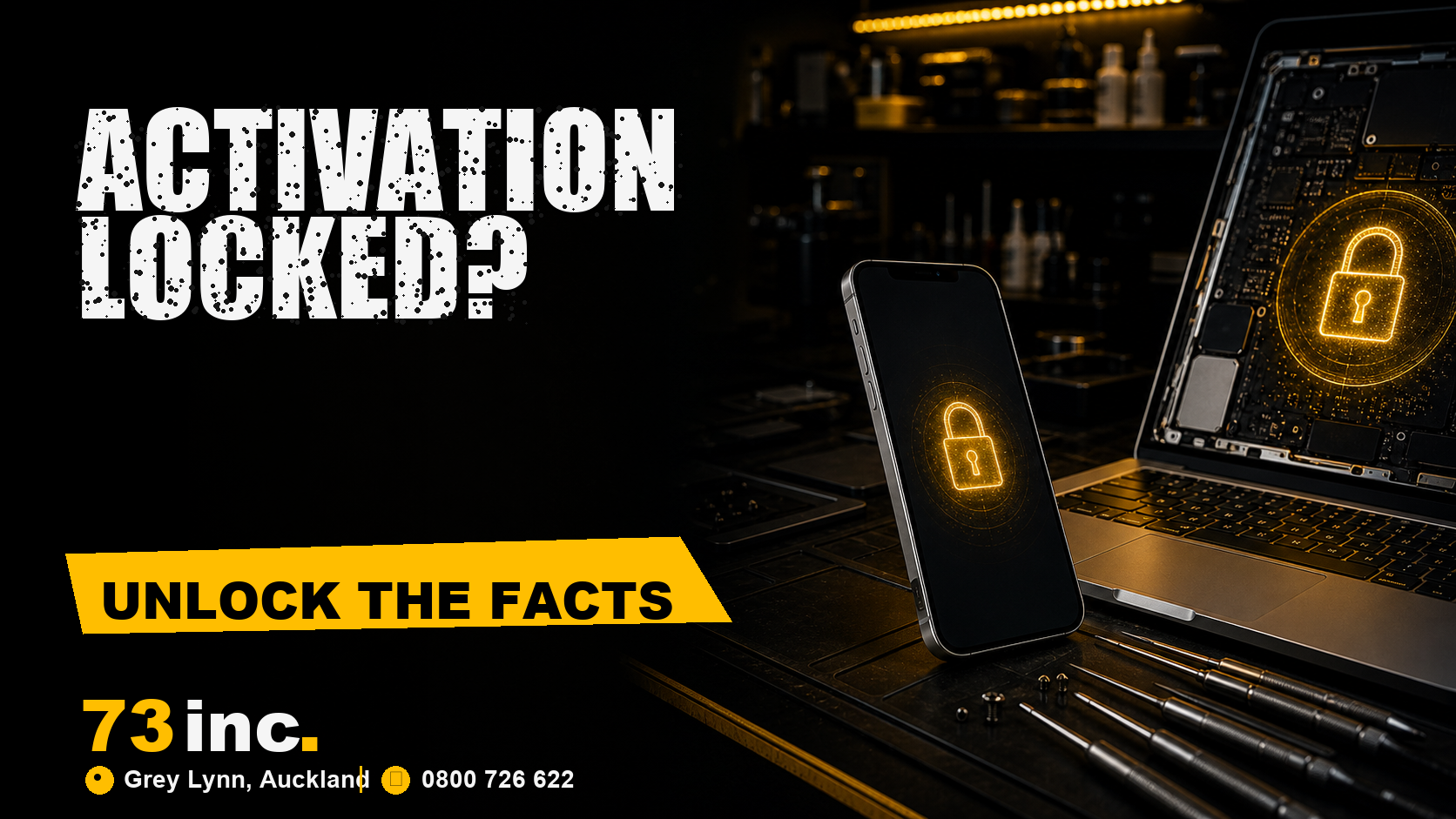
It’s one of the most common questions we’re asked at 73inc: “Can you remove the Apple ID?” or “Can you unlock this — it’s locked to someone else’s account?” Usually it’s someone who’s bought a second-hand MacBook or iPhone that’s still tied to the previous owner, and now they own a device they can’t use.
Here’s the honest, accurate answer — and why the distinction matters.
(Note: Apple now calls an “Apple ID” an “Apple Account.” We use both terms below, since most people still search for “Apple ID.”)
Can a repair shop remove or bypass Activation Lock?
Not if the device is linked to someone else’s Apple Account. A repair shop cannot legitimately bypass Activation Lock through a reset, a macOS or iOS reinstall, a logic board swap, or any ordinary repair. The lock can only be removed by the account holder, or potentially by Apple after reviewing acceptable proof of purchase.
This is by design. Activation Lock is Apple’s anti-theft feature, tied to the previous owner’s Apple Account through Find My. Its purpose is to make a lost or stolen device useless to anyone but the rightful owner. If it could be bypassed easily, it wouldn’t work.
So if a shop or an online service claims they can simply “unlock” a device tied to someone else’s account, treat that with real caution. That’s exactly the claim that surrounds stolen devices, and it’s not something a legitimate repairer offers.
One important distinction: “remove the Apple ID” can mean different things. Signing out of an accessible account on a working device, removing an old user account, or sorting a macOS login issue are routine jobs we may be able to help with. Bypassing Activation Lock when you don’t have the account holder’s credentials is a different matter — and that one genuinely can’t be done outside Apple’s own process.
Why is my second-hand Mac or iPhone locked to someone else’s account?
When someone sells or passes on an Apple device, they’re supposed to sign out of iCloud and remove the device from their Apple Account first. If they don’t, the device stays locked to their account — even though you now own it. When you try to set it up, it asks for their credentials and you can’t get past it.
This catches out a lot of honest buyers. The device isn’t faulty, and you haven’t done anything wrong — it just wasn’t properly signed out before it changed hands.
On Macs, Activation Lock generally applies to Apple-silicon models (M1 and later) and supported Intel Macs with Apple’s T2 Security Chip, so not every older Mac is affected.
What can I do if I’ve bought a locked device?
There are two legitimate paths, and no shortcuts:
1. Contact the original owner. This is by far the easiest fix. They can remove the device from their account in a couple of minutes — from any of their own devices in Settings, or by signing in at iCloud.com/find, selecting the device, and choosing “Remove This Device” when it’s available. Once they’ve done that, restart or erase the device and try activating again. In some cases the device needs to connect to the internet before its updated status is recognised.
2. Submit an Activation Lock support request to Apple. If you genuinely can’t reach the original owner, Apple may let you submit a request if you have acceptable proof-of-purchase documentation. Two things to know: Apple decides whether the documentation is sufficient, and submitting a request does not guarantee the lock will be removed. A handwritten receipt or a marketplace screenshot may not be enough.
Until the device is removed from that account, it can’t be set up or used. No repair changes that — it’s an account issue, not a hardware one.
How can I avoid buying a locked device?
Prevention is far easier than the cure. Before you pay for any second-hand Apple device:
- Ask the seller to sign out of iCloud and remove the device from their Apple Account in front of you.
- Connect it to Wi-Fi and begin setup, and confirm it completes without asking for the previous owner’s account. (Just reaching the “Hello” screen isn’t proof — Activation Lock can appear once setup begins and the device contacts Apple.)
- Confirm no Remote Management or device-enrolment screen appears (this indicates it was a managed business or school device).
- For a Mac, confirm Find My has been turned off before the seller erases it.
- Keep a proper receipt with the serial number and note the seller’s details.
If you’re unsure, bring it to us before you commit — we’re happy to help you check.
Quick answers
Will replacing the logic board remove Activation Lock?
No. Activation Lock is tied to the Apple Account, not a single component, so a board swap doesn’t clear it — and it isn’t a legitimate workaround.
Will reinstalling macOS or doing a DFU restore remove it?
No. Erasing and reinstalling the operating system doesn’t remove Activation Lock; the device re-checks the account status on activation.
Is a locked device just a paperweight, then?
Until it’s removed from the account, effectively yes — but when the situation is genuine, the fix is usually a simple two-minute action by the original owner. The key is to sort it before money changes hands.
Can 73inc check a second-hand MacBook before I buy it?
Yes. We can identify whether you’re dealing with Activation Lock, a forgotten passcode, a macOS login issue, Remote Management, or a hardware fault. We can’t bypass an Activation Lock tied to someone else’s account — but we can tell you exactly what you’re looking at and what the legitimate next step is, before you spend money unnecessarily.
The bottom line
A repair shop can’t legitimately bypass Activation Lock, and any service claiming otherwise should be treated with caution. But the lock can be removed through the proper channels — by the original owner in a couple of minutes, or by Apple with acceptable proof of purchase. The smart move is always to check a second-hand device is properly signed out before you pay, not after.
If you’ve bought a Mac or iPhone and you’re not sure what kind of lock you’re dealing with, bring it into 73inc in Grey Lynn and we’ll help you identify it. And if you’d rather buy a device you know is clean, we sell tested, warranted Apple devices that are ready to use out of the box.


