


![73inc blog image for MacBook Pro Touch Bar not lighting up [Solved] 2026](https://73inc.nz/wp-content/uploads/2026/07/macbook-pro-touch-bar-not-lighting-up-solved-2026-73inc-blog-hero-v3.png "MacBook Pro Touch Bar not lighting up [Solved] 2026 1")
You open your MacBook Pro, start working, and notice the Touch Bar is completely dark — no brightness, no icons, nothing responding to your touch. It’s frustrating, especially when you rely on it for shortcuts, media controls, or app-specific functions throughout your day.
The good news is that a dark or unresponsive Touch Bar is usually a software issue that can be resolved at home in a few minutes. This guide walks you through every fix — from the simplest to the most advanced — in the order you should try them. If it turns out to be a hardware problem, we’ll cover that too.At 73inc, we handle Touch Bar issues at our Auckland workshop regularly. But before you bring it in, work through these steps — there’s a good chance you’ll have it fixed before you finish reading.
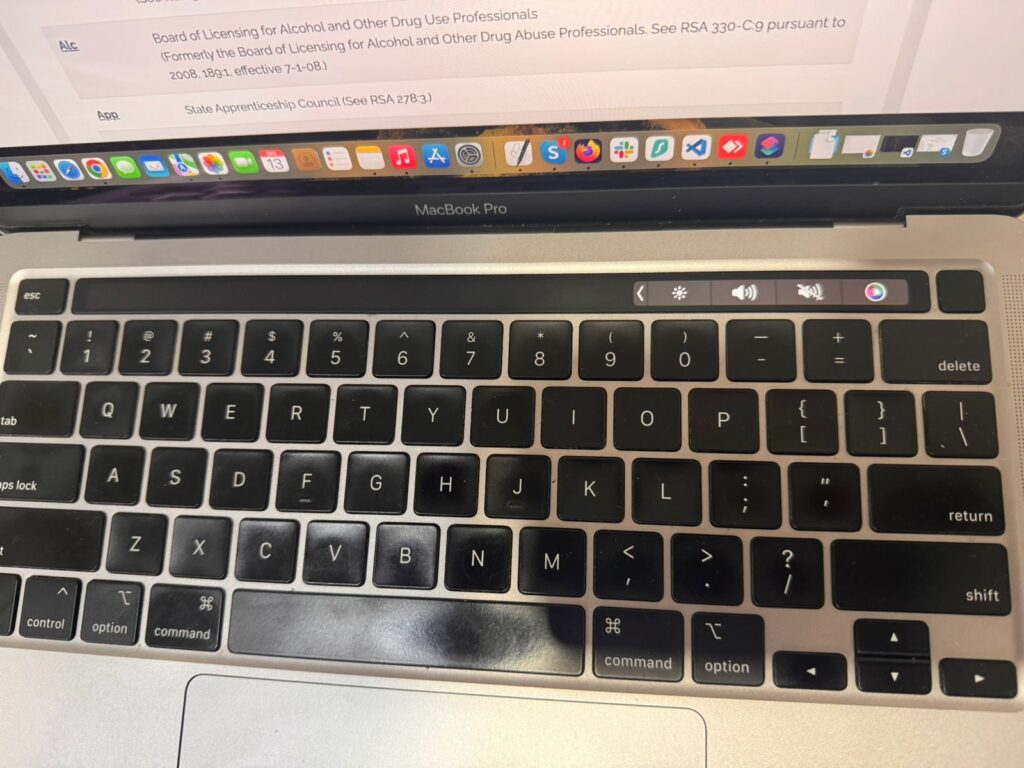
You open your MacBook Pro, start working, and notice the Touch Bar is completely dark — no brightness, no icons, nothing responding to your touch. It’s frustrating, especially when you rely on it for shortcuts, media controls, or app-specific functions throughout your day.
The good news is that a dark or unresponsive Touch Bar is usually a software issue that can be resolved at home in a few minutes. This guide walks you through every fix — from the simplest to the most advanced — in the order you should try them. If it turns out to be a hardware problem, we’ll cover that too.
At 73inc, we handle Touch Bar issues at our Auckland workshop regularly. But before you bring it in, work through these steps — there’s a good chance you’ll have it fixed before you finish reading.
Which MacBook Pro Models Have a Touch Bar?
First, a quick note. The Touch Bar was introduced in 2016 and discontinued in 2021. If you’re using one of the following models, this guide applies to you:
- MacBook Pro 13-inch (2016–2022)
- MacBook Pro 15-inch (2016–2019)
- MacBook Pro 16-inch (2019–2021)
MacBook Pro models from 2021 onwards (M1 Pro, M1 Max, M2 Pro, M3 Pro and later) replaced the Touch Bar with standard function keys. If you have one of those newer models and your function key row isn’t working, that’s a different issue — visit our keyboard problems page for guidance.
Why Is Your MacBook Pro Touch Bar Not Lighting Up?
Before jumping into fixes, it helps to understand what’s likely causing the problem. Here are the most common culprits:
Software and settings issues are by far the most common cause — things like the TouchBarServer process crashing, a corrupted cache file, an app conflict, or an outdated version of macOS. These are all fixable at home.
Brightness set to zero is surprisingly common. The Touch Bar has its own brightness setting that can get accidentally dragged to the minimum, making it look completely off even though it’s working fine.
External display connected can sometimes cause the Touch Bar to dim or go dark — this is a known macOS behaviour rather than a fault.
Overheating causes macOS to throttle various components, including the Touch Bar, to reduce power consumption. If your Mac is running hot, resolving the thermal issue often brings the Touch Bar back. Read more about MacBook overheating and performance issues.
Liquid damage is a hardware cause that requires professional attention. Even a small amount of moisture reaching the Touch Bar’s flex cable or connector can cause it to stop working. Our liquid damage repair service deals with this regularly.
Hardware failure — the Touch Bar flex cable, connector, or the Touch Bar unit itself can fail, particularly in older models. This needs hands-on diagnosis.
Fix MacBook Pro Touch Bar Not Lighting Up — 9 Methods
Work through these in order. Most users find a fix by Method 4 or 5.
Method 1: Check Touch Bar Brightness Settings
Before anything else, rule out a brightness issue. The Touch Bar has its own brightness that can be set independently from your display.
Step 1: Look at the Control Strip on the right side of your Touch Bar. Step 2: Swipe left or right on the brightness buttons to increase the Touch Bar brightness.
If you can’t see the Control Strip at all, try adjusting it through System Settings:
Step 1: Click the Apple menu → System Settings
Step 2: Click Displays in the sidebar
Step 3: Look for the Touch Bar brightness slider and drag it to the right
If the slider was at zero, this is your fix. Done.
Method 2: Restart Your MacBook Pro
A simple restart clears temporary system files, resets running processes, and resolves the majority of minor Touch Bar glitches. Always try this before anything else.
Step 1: Click the Apple menu → Restart Step 2: Wait for your Mac to fully reboot Step 3: Check if the Touch Bar is now lighting up
If it comes back after a restart but keeps going dark again, continue to the methods below — something is causing it to crash repeatedly.
Method 3: Reset the TouchBarServer Process
The Touch Bar is controlled by a background process called TouchBarServer. When this process crashes or freezes, the Touch Bar goes dark. Restarting it — without rebooting your entire Mac — is one of the most effective fixes.
Using Activity Monitor:
Step 1: Go to Applications → Utilities → Activity Monitor
Step 2: Type TouchBarServer in the search box
Step 3: Select it and click the X button to quit the process
Step 4: Close Activity Monitor — the process restarts automatically within seconds
Using Terminal (faster method):
Step 1: Go to Applications → Utilities → Terminal
Step 2: Type the following command and press Return:
sudo pkill TouchBarServer
Step 3: Enter your admin password when prompted and press Return
Step 4: Close Terminal
The TouchBarServer restarts itself immediately. Check your Touch Bar — this fixes the issue for most people.
Method 4: Force Quit and Restart the ControlStrip Process
If the TouchBarServer reset didn’t work, the ControlStrip process (which manages the right side of the Touch Bar) may also need a restart.
Step 1: Open Terminal (Applications → Utilities → Terminal) Step 2: Type the following and press Return:
killall ControlStrip
Step 3: Close Terminal and check the Touch Bar
Method 5: Update macOS
Bugs in older versions of macOS can cause Touch Bar display issues, and Apple regularly patches these in system updates. If you haven’t updated in a while, this is worth doing.
Step 1: Click the Apple menu → System Settings
Step 2: Click General → Software Update S
Step 3: If an update is available, click Update Now
Step 4: Wait for the update to install and your Mac to restart
After updating, check if the Touch Bar is working. If you’re experiencing other software-related issues alongside this, an update often resolves multiple problems at once.
Method 6: Clear Touch Bar Cache Files
Corrupted cache and preferences files can cause the Touch Bar to malfunction. Deleting them forces macOS to rebuild them fresh on next boot.
Step 1: Open Finder
Step 2: Click Go in the menu bar → Go to Folder
Step 3: Type ~/Library/Preferences/ and press Return
Step 4: Find and delete the file named com.apple.touchbar.agent.plist
Step 5: Now go to Go → Go to Folder again
Step 6: Type ~/Library/Caches/ and press Return
Step 7: Delete the contents of this folder (you can safely delete what’s inside — macOS will rebuild the cache)
Step 8: Restart your MacBook Pro
Check the Touch Bar after restart.
Method 7: Reset the SMC (System Management Controller)
The SMC controls low-level hardware functions including display behaviour, power management, and peripheral operation. Resetting it can resolve Touch Bar issues that won’t respond to software fixes.
For MacBook Pro with a T2 chip (Intel, 2018 and later):
Step 1: Shut down your Mac completely
Step 2: Press and hold Control + Option (left side) + Shift (right side) for 7 seconds ]
Step 3: While still holding those keys, also press and hold the Power button for another 7 seconds
Step 4: Release all keys, wait a few seconds, then press the Power button to turn on your Mac
For MacBook Pro without a T2 chip (Intel, 2017 and earlier):
Step 1: Shut down your Mac
Step 2: Press and hold Shift + Control + Option and the Power button simultaneously for 10 seconds Step 3: Release all keys and turn on your Mac normally
Note: Apple Silicon MacBooks (M1 and later) don’t have an SMC — simply restarting the Mac performs the same reset automatically.
Method 8: Reset NVRAM / PRAM
NVRAM stores settings related to display configuration, brightness, and startup preferences. A corrupted NVRAM entry can affect Touch Bar behaviour.
For Intel MacBook Pro only:
Step 1: Shut down your Mac
Step 2: Turn it on and immediately press and hold Option + Command + P + R together
Step 3: Hold these keys for about 20 seconds until you hear the startup sound a second time (or see the Apple logo appear and disappear twice)
Step 4: Release the keys and let your Mac boot normally
Apple Silicon MacBooks manage NVRAM differently and don’t require this step.
Method 9: Boot into Safe Mode
Safe Mode loads macOS with only essential processes and disables third-party extensions. If the Touch Bar works in Safe Mode but not normally, a third-party app or extension is interfering with it.
For Intel MacBook Pro:
Step 1: Shut down your Mac
Step 2: Turn it on and immediately hold the Shift key
Step 3: Release Shift when you see the login screen — you’ll see “Safe Boot” in the top-right corner
For Apple Silicon MacBook Pro:
Step 1: Shut down your Mac
Step 2: Press and hold the Power button until you see startup options
Step 3: Select your startup disk, then hold Shift and click Continue in Safe Mode
Check your Touch Bar in Safe Mode. If it works, restart normally and uninstall any recently added apps or extensions one by one until you find the culprit. Our software troubleshooting service can help identify problem applications if you’re unsure.
When the Touch Bar Issue Is Hardware — Signs to Watch For
If you’ve worked through all nine methods above and your Touch Bar is still dark, the problem is almost certainly hardware-related. Here are the signs that point to a physical fault:
- Touch Bar stays completely black even in Safe Mode and after SMC reset
- Touch Bar works intermittently — lighting up randomly and going dark again, often linked to a loose flex cable
- Recent liquid spill — even a small amount of moisture can damage the Touch Bar connector or the unit itself. Our liquid damage repair team can assess the extent of damage
- Recent physical impact — a drop or knock can dislodge the Touch Bar’s internal connector
- Touch Bar flickering or showing partial brightness — a failing backlight or damaged Touch Bar strip
- Other keyboard issues alongside it — if your keyboard is also playing up, both faults may share a root cause. See our keyboard problems page for related issues
Hardware Touch Bar repairs require disassembly of your MacBook Pro and replacement of either the flex cable or the entire Touch Bar unit. This is not a DIY repair — attempting it without experience risks damaging the logic board or surrounding components. Our MacBook repair specialists in Auckland handle this regularly.
Quick Troubleshooting Reference
| Symptom | Most Likely Cause | First Fix to Try |
| Touch Bar completely dark, Mac works normally | TouchBarServer crashed | Method 3 — restart TouchBarServer |
| Touch Bar very dim but visible | Brightness set too low | Method 1 — adjust brightness |
| Touch Bar dark only when using one app | App conflict | Method 9 — Safe Mode test |
| Touch Bar dark after macOS update | Software bug | Method 5 — update macOS / Method 7 — SMC reset |
| Touch Bar intermittently working | Loose flex cable | Professional diagnosis needed |
| Touch Bar dark after liquid spill | Liquid damage | Professional repair — contact us |
| Touch Bar dark after a drop | Physical damage | Professional repair — contact us |
Frequently Asked Questions
Why does my MacBook Pro Touch Bar keep going dark randomly?
Intermittent Touch Bar blackouts are most commonly caused by the TouchBarServer process crashing repeatedly. Try Method 3 first. If it keeps happening, a corrupted cache file (Method 6) or a third-party app conflict (Method 9) is likely the cause.
Does the MacBook Pro Touch Bar have its own brightness setting?
Yes — the Touch Bar brightness is separate from your display brightness. It can be adjusted via the Control Strip on the Touch Bar itself, or through System Settings → Displays. Many people accidentally set it to zero without realising.
Can a software update break the Touch Bar?
Yes, this does happen occasionally. If your Touch Bar stopped working right after a macOS update, try an SMC reset (Method 7) and NVRAM reset (Method 8). Apple typically patches these bugs quickly in follow-up updates.
My Touch Bar is completely unresponsive to touch as well as dark — is it hardware?
Not necessarily. A crashed TouchBarServer process causes both the display and touch input to fail simultaneously. Try Method 3 first. If the Touch Bar is still unresponsive after all software fixes, it’s likely a hardware issue.
How much does it cost to repair a MacBook Pro Touch Bar in Auckland?
The cost depends on whether it’s a cable issue or the Touch Bar unit itself needs replacing. Bring your MacBook Pro to 73inc for a free initial assessment — we’ll diagnose the issue and give you an upfront quote before any work begins.
Is it worth repairing a Touch Bar MacBook Pro in 2026?
In most cases yes, particularly if your machine is otherwise in good condition. Touch Bar MacBook Pros are still capable machines for everyday use, and a repair is significantly cheaper than replacement. Our MacBook repair team can advise based on your specific model and condition.
Can liquid damage cause Touch Bar issues even without other signs?
Absolutely. The Touch Bar’s flex cable runs near areas of the MacBook Pro that are vulnerable to liquid ingress. Even a small coffee or water spill that seems to have dried up can cause corrosion that affects the Touch Bar without visibly damaging other components. Our liquid damage assessment can identify hidden moisture damage.
Still Not Fixed? Let 73inc Take a Look
If you’ve worked through every method in this guide and your Touch Bar is still dark, it’s time for a professional diagnosis. Some issues — particularly failing flex cables, damaged connectors, or hardware faults from liquid or physical damage — simply can’t be fixed with software.
At 73inc in Grey Lynn, Auckland, we:
- Provide a free initial assessment before any work is agreed
- Give you an upfront, transparent quote with no hidden costs
- Back all repairs with a 90-day warranty
- Handle everything from keyboard and Touch Bar repairs to logic board work and liquid damage restoration
- Complete most repairs within 1–3 business days
📍 55b Pollen Street, Grey Lynn, Auckland 📞 0800 726 622 ✉️ info@73inc.nz 🕘 Monday–Saturday, 9am–5pm


